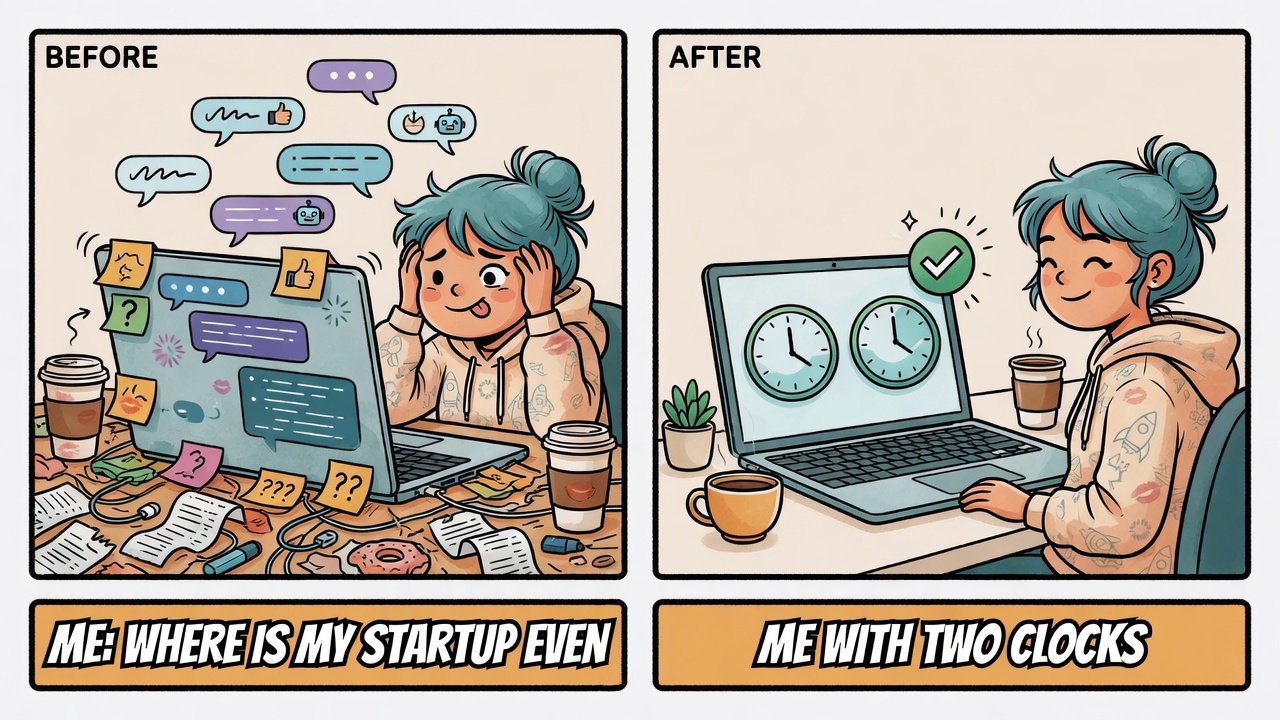
Traditional startup advice is blunt: pick one idea, pour 110% into it, stay fundable, pray the market agrees. Focus becomes a moral law. Curiosity about a second bet becomes a character flaw.
That rule is not completely wrong. Scattered attention without gates is how founders die of busy fog. But the orthodoxy is incomplete. It was shaped for a world of pitch decks and single-narrative raises — not for solo founders who can now learn, test, and ship at AI speed across more than one honest experiment.
Here is the permission we actually give mentees — and the condition that makes it safe:
You may run more than one idea. Each idea must face honest market-validation gates. No shortcuts. No “we’ll get lucky” without iterate and grind. The board must show where each bet stands.
Bootstrap OS is the vehicle for that condition: two clocks, weekly “Where are we?”, founder gates (Advance / Iterate / Hold / Kill), evidence over pep talk. Below is the mentee picture first — then how we dogfood the method on Totbox and Pirin, and run every other bet (including zk0) through the same filter without pretending three green dashboards equal three wins.
Against the 110% single-idea cult
The mono-focus story sells cleanly to investors: one market, one ICP, one slide. Clean is not the same as true. Plenty of durable founders held parallel bets, sequential pivots, or a research track beside a cash track — what failed was lying about status, not the existence of a second hypothesis.
What actually kills multi-idea founders is not “two ideas.” It is:
- No board — chat amnesia instead of journey phase and weekly loop
- Counting passive interest as engagement or payment
- Advancing every bet on vibes so nothing gets a real kill or hold
- Using “I’m focused” as cover while the paid path stays foggy
So we do not preach chaos. We preach responsible multi-idea founding: explicit primary focus this week, and honest gates on everything else still alive.
OK · multiple ideas
- · Each has a written hypothesis under evidence
- · Each has visible gates (interest ≠ engagement ≠ pay ≠ scale)
- · Weak gates get Iterate / Hold / Kill — not story cover
- · You name which idea is primary this week
Not OK · shortcuts
- · Skip gates because the domain is “hot”
- · Count passive interest as real-user engagement
- · Run three fake green dashboards for LinkedIn
- · Hope for luck instead of designing the next test
Why multi-project is newly feasible (honest substantiation)
Permission without economics is a pep talk. The mono-focus rule made more sense when each parallel idea was ruinously expensive. Until roughly the last few seasons of tooling (late 2025 into mid-2026), a second serious bet usually meant another engineering hire, another multi-week build, or burning the only co-founder you had. Under those costs, “pick one” was often the only solvent advice.
What changed is not human nature. What changed is the marginal cost of a small, honest experiment — with clear limits on what that claim covers.
Then · expensive bet
One parallel idea often meant another hire, another runway burn, another full product stack. Rational response: single-thread or die.
Now · cheap experiment
A second hypothesis can mean a tiny slice, a waitlist, a synthetic rank, a cold path — if you keep scope brutal and gates visible.
Still expensive
Your judgment hours, customer relationships, and reputation. Multi-bet without a board still bankrupts attention.
Cost of a thin build
Outside facts + company signals
Weeks–months of eng hire or co-founder bandwidth per slice
Hours–days for a constrained MVP with AI coding tools (when scope stays tiny)
Cost of a first research pass
Assumed capability until real proof
Slow manual interviews before any ranking of customer groups
Synthetic stress + light real tests in days; still need real world for the gate
Who can run the loop
Outside facts (tooling mid-2026)
Often blocked without a technical co-founder for every bet
Solo / non-tech founders can direct agents for many thin experiments
What did not get cheaper
Needs real-world proof
Customer trust, payment, judgment, coordination tax
Still scarce. AI does not buy attention or sign checks for you
What we can claim (and how we label it)
- Outside facts / industry signal: AI-assisted coding and agentic workflows crossed a usability line for many non-technical founders. Thin web products, forms, and internal tools that once required a specialist can often be directed in natural language and reviewed in days, not months — when scope stays tiny. We wrote a practical tool matrix in Vibe Coding Reality Check Mid-2026 and a longer 2026 landscape in State of Vibe Coding 2026. Industry write-ups through 2026 also report large non-developer shares of vibe-coding usage — treat that as capability diffusion, not proof your market will pay.
- Outside facts / research loop: Synthetic customer stress and structured ranking can run in hours. That is a filter, not real-world validation. Bootstrap OS still demands a real engagement or payment gate before you celebrate. See How Bootstrap OS actually runs research.
- Company signals (Pirin mentoring): In Ground Level and related work we see founders ship customer-facing slices and ops tooling without a classic technical co-founder on day one. That is a signal about build leverage, not a claim that every mentee’s second idea will work.
- Needs real-world proof (unchanged): Willingness to pay, deep engagement, and distribution still require humans doing human things. AI does not clear those gates. zk0’s open interest without tangible contribution is an example of a filter that passed and a gate that did not.
What we are not claiming
- That you should run five startups as a personality brand
- That multi-bet works the same for large teams (coordination tax rises fast)
- That “vibe coded” equals production-safe or fundable
- That cheaper tests replace judgment, ethics, or weekly honesty
So the updated advice is economic as well as moral: multi-project is more feasible because cheap tests are more feasible. The founders who fail multi-bet in 2026 usually fail the same way as before — no board, no kill criteria, activity mistaken for proof — only faster.
That is why Bootstrap OS pairs permission with a control plane. AI made the experiments affordable. The OS keeps them honest.
For mentees: the clear picture of where you stand
Whether you hold one idea or three, each bet needs a board you can read like a car dashboard — speed, fuel, warning lights — not a novel of chat threads. You do not need a computer science degree to fill it.
1. Write what you are testing
Hypothesis (one sentence · subject to evidence)
[What problem, for whom, why now, why you]
Who
≥3 customer groups ranked — not one favorite only
What ships today
The tiny surface people can already touch
What you sell
The paid (or clear value) path still under proof
2. Run two clocks (this is the whole game)
Most founders run one vague clock called “progress.” That is how you stay busy and lost at the same time.
Where is the company on the 0→1 path? You gate every move.
- 1Thesis + customer groupsWhat problem, for whom?
- 2Success definitionsDone means… for each group
- 3Synthetic researchAI stress-test the groups
- 4Real research + $ stressTalk / waitlist / will they pay?
- 5Tiny designSmallest system that can test the winner
- 6Build hardTiny slice + honest tests
- 7Real usersObserved behavior, not compliments
- 8Learn / improveTraces + score movement
- 9ScaleOnly after clear proof
Advance · Iterate · Hold · Kill — founder only. Scale (9) stays blocked until proof.
What did we learn this week? Many cycles can live inside one journey phase.
- 1Synthetic research
- 2Validate / concept
- 3Build
- 4Test
- 5Evaluate
- 6Real feedback
- 7Memory update → back
Stage 7 writes memory, then wraps back to stage 1. Busy weeks without stage 7 are amnesia.
3. Fill the control plane every week
Your company
Hypothesis: [one sentence — subject to evidence]
Journey · slow
N / 9
[phase name]
Loop · fast
M / 7
[stage name]
Gate
OPEN · WAIT · BLOCK
Can we advance?
Autonomy
Strict · Auto · Danger
Default: Strict
Ready for eyes
unknown · blocked · green
Cold path?
Weekly snapshot
date or missing
Ritual stamped?
Top open questions
- • …
- • …
Most impactful next focus
Advance / Iterate / Hold / Kill — founder decides (see gate menu below)
4. Know how value is supposed to flow
1 · People
Your customer groups (ranked, not everyone)
2 · Soft path
Content, waitlist, free help, early demos
3 · Paid / clear value
The thin slice you are trying to sell or prove
4 · Proof
They pay or get clear value you can observe — and can run without you
Soft path can be loud. The company only “works” when the yellow step becomes green proof.
5. Separate activity from proof
Activity vs proof · where to put next focus
High activity · High proof
Protect & deepen
Keep the slice; improve quality. Do not spray into new markets yet.
High activity · Low proof
Most founders live here
Shipping, posting, mentoring, coding — without paid or observed value. Tighten the paid slice.
Low activity · High proof
Rare · lucky
Proof appeared with little motion. Document it. Do not assume it scales itself.
Low activity · Low proof
Start simple
Write thesis + 3 groups. Run one honest loop. Do not build a platform first.
6. Score honestly (so next focus is obvious)
Your numbers go here. Bars start unset (not “we scored zero”). Fill only from evidence — later in this article you will see a filled Pirin example.
Rule: raising “product ships” on a weak “they will pay” is less valuable than proving (or killing) the paid path.
7. Ready for human eyes (before you burn early adopters)
Surface A · may be green
Public site / form / happy path
A cold person can finish the path without you babysitting. Green here means the path works — not that people will pay.
Surface B · often unknown
The product you have not delivered yet
Cohort, core app, or paid experience still in waitlist form. Keep status unknown until a cold path exists. Do not mix A and B.
8. Pick the gate — that is your next focus
Founder decision · most impactful next focus
After you fill the board, pick one. The OS does not pick for you.
Stay on this phase. Finish memory, clear a blocker, lock pass/fail numbers.
Stay in phase. Fix the weak evidence, slice, or customer rank.
Only when exit criteria are met with evidence. AI never does this alone.
Hypothesis is weak. Stop protecting it. Free attention for a better bet.
9. Keep files boring and findable
ivelin/bootstrap
└── portable rules (shared with any founder)
your-company/
├── company/state/…json
└── “Where are we?” machine truth
├── docs/company-os/
├── applied-here.md · thesis · scores
├── research/icps/
├── traces/decisions/
└── product code + tests
└── how you ship — not the whole company OS
When a mentee can point at the board and say “Journey 4, loop 2, gate Hold, focus = monetization stress on group #2,” the OS is working. When they can only say “we’ve been grinding,” it is not.
Why we run the same OS on two companies
We already dogfood Bootstrap OS on Totbox (home-service job coordination). That instance is useful. It is incomplete if we stop there.
Pirin.ai is the company that teaches Bootstrap OS. If Pirin does not run the OS, we sell a gym membership we never use.
So we extracted the portable template to github.com/ivelin/bootstrap and instantiated it on Pirin — same two clocks and gates, different thesis, different honest gaps.
Portable template
Bootstrap OS
Two clocks, gates, evidence rules, thin AI instructions. Process only — no market baked in.
ivelin/bootstrap
Instance A
Totbox
Home-service job coordination. Steal discipline — not HVAC as your default business.
Instance B
Pirin.ai
Founder studio + Bootstrap OS intensive. The company that teaches the OS must also run it.
Golden rule: copy process and control. Do not copy another founder’s market, customer list, or “current hypothesis” as yours.
Totbox dogfood
- Domain: physical home services · job coordination
- Customers: households / real jobs
- OS forces: real-job write-ups and business thresholds — not only smoke tests
- Honest gap: engineering can look green while payment and household proof stay open
Pirin dogfood
- Domain: founder education · OS install · mentoring
- Customers: solo non-tech founders (FI alumni, intensive seekers)
- OS forces: paid intensive path + ICP rank — not only content volume
- Honest gap: waitlist and free mentoring are loud; cohort revenue still unproven
How we live it: Totbox, Pirin, and the same filter on everything else
Full weekly boards today: Totbox and Pirin. That is enough to dogfood process across two markets without turning the founder into a dashboard janitor — and enough to prove multi-idea is not a slogan.
We also hold other bets — including zk0.bot (federated learning for robotics AI). Those bets are not exempt from the 110% orthodoxy’s real lesson (stay honest). They go through the same Bootstrap OS filter: evidence labels, honest gates, no narrative cover because the domain is exciting.
Federated learning for robotics AI — open research and community. Subject to the same Bootstrap OS filter as Totbox and Pirin. No exemption for “hot domain.”
Passed · interest filter
Open source and subject interest are real. People care about the problem space.
Not passed · real engagement
Passive interest ≠ contribution that moves the project. Learning and participation thresholds are still high.
Interest is not engagement. Engagement is not payment. Payment is not scale. No shortcuts. You still iterate and grind; luck is what you meet after designed tests, not a substitute for them.
Totbox rails (illustration only)
Snapshot for pattern recognition — not your default business. Details live in Totbox’s instance docs.
Slow clock · journey rails
- 1Thesis + customer groups
- 2Success definitions
- 3Synthetic research
- 4Real research + $ stress
- 5Tiny design
- 6Build hardyou
- 7Real users
- 8Learn / improve
- 9Scale
Fast clock · weekly loop rails
- 1Synthetic research
- 2Validate / concept
- 3Build
- 4Testyou
- 5Evaluate
- 6Real feedback
- 7Memory update → back
After stage 7, the loop returns to 1. Journey stays put until you Advance.
Pirin rails (teaching company dogfood)
We filled the same blank boxes for this company.
Non-technical solo founders will install and run a Bootstrap OS with structured help — and a paid intensive (plus free Ground Level for FI-equivalent alumni) can prove and monetize that value.
Non-tech solo founders will install a Bootstrap OS with structured help — and a paid intensive (plus free Ground Level for FI alumni) can prove and monetize that value.
Journey (slow)
6 / 9
Build — product ships
Loop (fast)
6 / 7
Real feedback
Gate
Open
Not PMF
Autonomy
Strict
Founder keeps keys
Ready for eyes
Mixed
Site green · intensive unknown
Weekly snapshot
Missing
Ritual not yet stamped
Slow clock · journey rails
- 1Thesis + customer groups
- 2Success definitions
- 3Synthetic research
- 4Real research + $ stress
- 5Tiny design
- 6Build hardyou
- 7Real users
- 8Learn / improve
- 9Scale
Fast clock · weekly loop rails
- 1Synthetic research
- 2Validate / concept
- 3Build
- 4Test
- 5Evaluate
- 6Real feedbackyou
- 7Memory update → back
After stage 7, the loop returns to 1. Journey stays put until you Advance.
Pirin · how value is supposed to flow
People
FI alumni · solo non-tech founders
Soft
Insights · waitlist · free Ground Level
Paid hypothesis
Bootstrap OS Intensive · Next Level?
Proof
They pay · they can run their own weekly loop
Mentoring, reviews, FI fit — not a large-N study
Waitlist / pre-order only — no cohort revenue yet
Site, forms, MCP, tests
Decision traces and weekly stamp thin
Free Ground Level is loud; paid path unproven
Rule: raising “product ships” on a weak “they will pay” is less valuable than proving (or killing) the paid path.
Surface A · may be green
Public site / form / happy path
A cold person can finish the path without you babysitting. Green here means the path works — not that people will pay.
Surface B · often unknown
The product you have not delivered yet
Cohort, core app, or paid experience still in waitlist form. Keep status unknown until a cold path exists. Do not mix A and B.
Pirin · what the gate is waiting on (most impactful focus)
- 1Is the intensive the primary paid beachhead, or Ground Level → Next Level?
- 2What numbers lock the first paid cohort (price, seats, completion, conversion)?
- 3Which customer-group rank survives one honest reward/risk pass?
- 4When is the next weekly “Where are we?” stamped?
- 5What Hold/Kill rules apply after one cohort cycle?
Common-sense next focus for us: not another insight post — lock pass/fail numbers and stamp a weekly snapshot while real feedback is already flowing.
Product build OS vs company OS
Pirin already had Spec-Kit for shipping product correctly. That is not the same as a company OS for the 0→1 path.
Product build OS
Spec-Kit (example)
Spec → plan → implement → test. Ships the slice correctly.
Failure mode: broken deploy, skipped tests, foggy requirements.
Company OS
Bootstrap OS
Journey · loop · scores · gates. Decides the business path this week.
Failure mode: busy content calendar, weak paid proof, phase advances on vibes.
What dogfooding forces us to stop saying
We're in scale mode
Journey 9 is blocked until proof
Waitlist is demand
Waitlist is interest; payment is demand
Engineering done = business ready
Completion score ≠ willingness to pay
We wrote the OS articles, so we run the OS
Articles are output; state + weekly snapshot are control
Green Ready for eyes = PMF
Green means the cold path works for that surface
You drive. The vehicle is shared.
You drive (every instance)
- · Your thesis and customer groups
- · Advance / iterate / hold / kill
- · What counts as proof in human words
- · When to open a paid offer
Shared vehicle
- · Two clocks + weekly "Where are we?"
- · Evidence labels over pep talk
- · Strict autonomy by default
- · Ready for human eyes before careless asks
How you install without copying our markets
- Open the template: github.com/ivelin/bootstrap
- Copy
templates/into your repo (docs/company-os/,company/state/). - Paste thin rules from
company-os/ai-instructions.mdinto your main AI instructions. - Fill your thesis and at least three customer groups.
- Fill the control plane. Answer “Where are we?” every week in under two minutes.
- Pick one gate: Advance / Iterate / Hold / Kill. Never advance the slow clock without evidence.
Optional hands-on path: Install Bootstrap OS intensive (waitlist) — teaching product, not required to use the open template.
Closing
Totbox proved the OS can sit next to a real product and refuse to lie about household proof.
Pirin has to prove the OS can sit next to a teaching company and refuse to lie about paid founder outcomes.
zk0 reminds us that open interest is only one gate: until real engagement produces tangible progress, the honest label is Iterate — not “we made it.”
For mentees, the win is simpler: a board so clear that anyone in the room can see the 0→1 position and name the most impactful next focus without a pep talk — even when you hold more than one idea.
If you teach an operating system, run it on the companies you fully operate — and run every other bet through the same honest filter. Fill the board until “Where are we?” is boringly easy. Iterate. Grind. Find the luck.
Series map
- Where your startup stands — blueprint
- How research runs — live research loop
- Solo OS → YC QM — when coordination tax rises
- Ready for human eyes — ship gate before product asks
- This article — permission for multiple ideas + honest gates + dogfood